

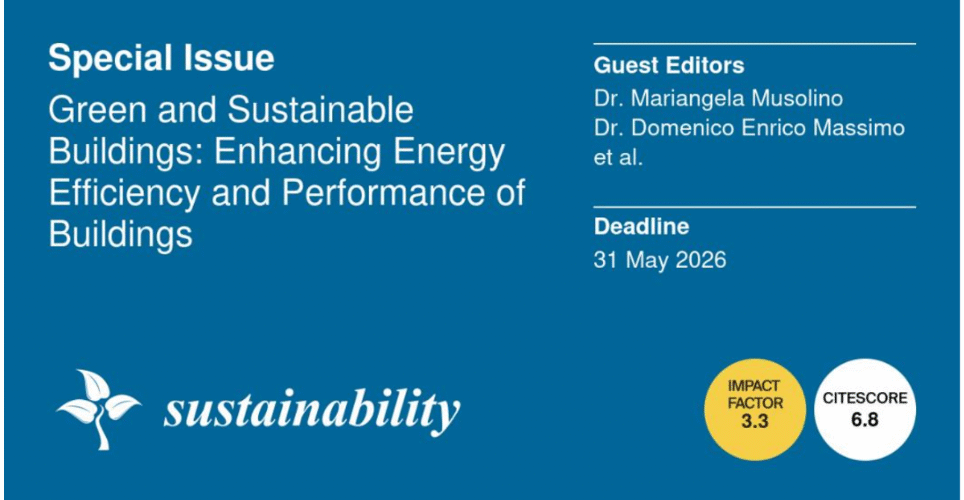
A special issue of Sustainability (ISSN 2071-1050). This special issue belongs to the section “Green Building“.
Deadline for manuscript submissions: 31 May 2026
Dear Colleagues,
Global climate change profoundly affects the survival and development of human beings, and the construction industry is one of the main sources of greenhouse gas emissions. Residential buildings are the most numerous type of building in the construction market, and countries around the world are committed to the development of green buildings for residential uses to reduce energy consumption and greenhouse gas emissions. In many countries, the majority of existing homes are energy inefficient; therefore, the development of green, efficient and habitable residential building has become an inevitable trend in the sustainable development of buildings around the world.
According to statistics on EU construction “Roughly 75% of EU building stock is energy inefficient. 85-95% of EU buildings are expected to still be standing in 2050”. The European Union is now committed to retrofitting buildings in order to meet the goals of the Paris Agreement, which includes improving the energy efficiency of existing residential buildings and reducing their greenhouse gas emissions.
Therefore, urgent and conscious intervention, aimed at reducing the energy needs of buildings and integrating energy needs with financial ones, is required.
The construction and retrofitting costs of green buildings are key factors that hinder their promotion and research is required to create and to establish a set of economic assessment systems and environmental–economic assessment tools for green residential buildings and the green renovation of existing residential buildings.
This Special Issue is part of the new frontier of energy analysis and valuation, and is focused on the development of new tools to enhance energy efficiency in buildings for sustainability. The aim is to gather together papers (original research articles and review papers) that can contribute to improving energy efficiency in buildings for sustainability.
One particular contribution of this Special Issue to the existing literature comes in the form of supplementing rare real-world case studies of building “greening” (id est, energy efficiency enhancement) by adopting nature-based approaches, products, and materials.
Dr. Mariangela Musolino
Dr. Domenico Enrico Massimo
Dr. Francesco Calabrò
Guest Editors






Add comment